How to Set Up Direct Deposit at Babies R Us
R. Kelly'south Trial Is Finally Set to Begin
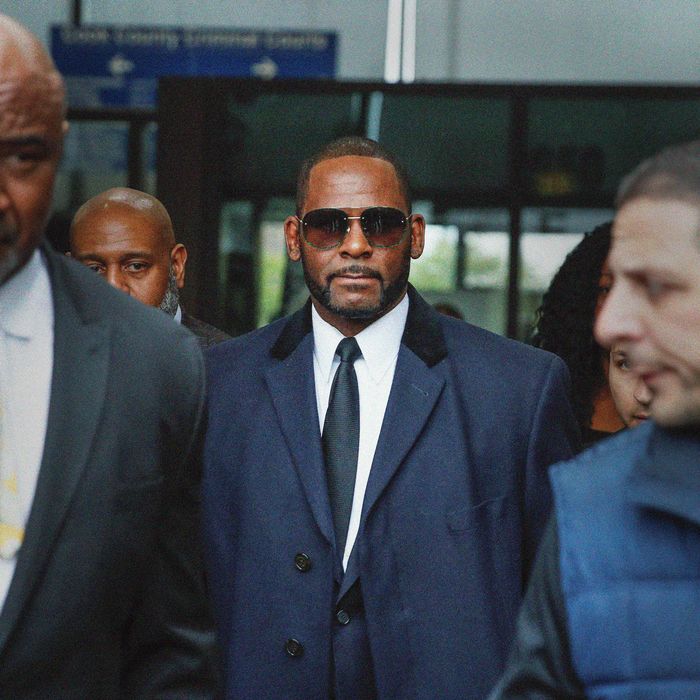
Photo: KAMIL KRZACZYNSKI/AFP via Getty Images
Jury selection begins today in the New York case against R. Kelly, who is facing more than xx years in prison if bedevilled. Federal prosecutors allege that the singer engaged in a decades-long pattern of preying on young women and girls for the purpose of coercing sex. Co-ordinate to the indictment, Kelly's criminal racketeering centered on the sexual exploitation of five "Jane Doe" victims, including the transportation of women and girls across land lines to engage in illegal sexual activity.
The example confronting Kelly has been widely heralded equally a Me Likewise–era turning betoken. As the Brooklyn U.S. Attorney put it, "This indictment makes clear that fame and power volition non shield anyone from prosecution, especially predators who victimize vulnerable members of our communities for their own sexual gratification." Fifty-fifty so, the limits of this evolution are as significant every bit the progress it marks. Still today, as Me Too continues to reflect, powerful men remain generally protected from consequences for their abuse. Understanding why — why it took then long to get here with Kelly, and why countless abusers will escape justice — is essential to transforming an enduring culture of dispensation.
The answer, in role: Kelly's victims were surrounded by people who didn't care enough to help. While the commonage indifference to their well-being was extreme, this indifference is not exceptional. It'south systemic, and an integral office of what I call the credibility complex. Without realizing it, we're shaped by a cluster of forces that corrupt our judgments, making united states also quick to discount the credibility of accusers and inflate the credibility of men accused. The most vulnerable women experience the steepest credibility discounts, while men with social condition and privilege benefit from the largest brownie boosts.
A finding of credibility encompasses not just a belief that the abuse happened, but also the belief that it matters. Just as determinations nigh trustworthiness are meted out in means that correspond to social power, so also is our care distributed unevenly and predictably: The suffering of an abuser who could face accountability for his misdeeds matters far more than the suffering of his victim. I call information technology the intendance gap. Because care is distributed forth lines of power, we tend to care less about some victims than others. Marginalized accusers are the almost readily dismissed.
In 1994, a 27-year-old Kelly illegally married his protégé Aaliyah, then 15 years onetime and too immature to legally wed. Although their marriage was later annulled, accounts of Kelly abusing teenage girls continued to surface. By the tardily 1990s, several women sued Kelly, claiming he abused them when they were underage.
And so, in 2002, at the top of his career, Kelly was charged with multiple counts of child pornography, discovered when a videotape was sent anonymously to the Chicago Sun-Times. Kelly'southward yearslong trial featured a video that allegedly depicted Kelly having sexual practice with, and urinating on, a 14-year-old girl who chosen him "Daddy." Nonetheless, despite the all-time efforts of prosecutors, Kelly was plant not guilty — an acquittal that "concretized a message that Black girls are disposable," as the writer Ida Harris observed.
That Kelly's many accusers have thus far been denied legal redress is no anomaly. The protection of rape constabulary has long been withheld from the nearly vulnerable victims. This overlook is an offshoot, and a driver, of the intendance gap. When Blackness women were slaves, their rape — whether by white masters or by Black men — was lawful. In keeping with this approach, when the Mississippi Supreme Court dismissed charges against a male person slave in 1859, it made clear that the rape of a young Black girl was not a crime. "Masters and slaves can not be governed by the same system or laws; so dissimilar are their positions, rights and duties," wrote the courtroom. Other state courts reached the same conclusion, dismissing indictments where the victim was not white.
Change was slow and incomplete. In 1860, the Mississippi legislature criminalized the rape of a Blackness daughter under the age of 12 by a Black homo, while nevertheless allowing the rape of Blackness women and the rape of Black girls by white men. Rape statutes finally became race-neutral after the Civil State of war. But harm to Black women and girls oftentimes went untouched by police force, and this remains truthful today.
"The fact his victims have been dismissed has everything to do with the fact they are Blackness girls," dream hampton, one of the executive producers behind the critically acclaimed 2019 documentary Surviving R. Kelly, stressed to Harris in her Elle interview.
Kelly's declared abuse was well-known in certain circles for decades. (Kelly denies the allegations against him.) In his book Soulless, music critic Jim DeRogatis identifies 48 victims of Kelly's abuse. "Just equally agonizing," DeRogatis writes, "I put the number of people who knew nearly or witnessed that damage in the thousands." Among them, DeRogatis mentions employees of tape studios and labels, radio stations, magazines, newspapers, hotels, restaurants, high-terminate gyms, and nightclubs. Also on the list are Kelly's lawyers, accountants, drivers, security guards, and swain musicians. "Blame a lack of empathy and morality nearly as sickening as Kelly's," DeRogatis explains.
Information technology'due south tempting to think that the reason Kelly managed to prey on so many young women for and so many years was that no one knew what was happening. Merely this piece of cake narrative lets far too many people — thousands, according to DeRogatis — off the hook. People around Kelly benefited from his phenomenal distinction and flourishing career. Fans loved his music and wanted more of it. Kelly escaped accountability because his continued success was worth more than than the lives of his victims.
Our tendency to drag the importance of abusers exacerbates the intendance gap. When our concern for the accused homo and the harm he'll suffer if held to account outweighs our concern for his victim, we don't act. Information technology volition come as no surprise that powerful men benefit most from this excess of cultural regard. For those already situated at the top and for those with a recognized entitlement to a "vivid hereafter," fame, fortune, and prominence confer dispensation. The culture that supports and affirms these men exerts a powerful gravitational pull toward protecting them.
As R. Kelly'south trial unfolds, we tin can expect to see powerful evidence of how the brownie complex harms some victims more than others. Most notably, Black girls and women are at an extreme disadvantage when their worth is stacked against their abusers'. "No i peculiarly cares that they are being abused," writes Moya Bailey, a feminist and critical race studies scholar who coined the term "misogynoir." At the same time, Blackness girls are oftentimes treated like fully adult adults, rather than children who require intendance — what researchers call "adultification." Considering they are seen every bit less in need of "protection and nurturing" than white girls, Blackness girls' sexual violation tends to matter least.
Should Kelly be convicted, it will communicate a different, powerful message. Philosopher Jean Hampton, among others who identify the expressive theory of punishment, has suggested that punishing an offender can equalize the social standing of the victim. When a person is violated, her status is diminished. The abuser has treated her equally less valuable than he, which is non what she deserves. Punishment of the abuser communicates that this is incorrect and affirms the opposite proffer: The victim is no less important than he. On the contrary, she is valued, respected, and worthy of protection.
But it would be a mistake to think that 1 conviction, nonetheless meaningful, can eliminate the intendance gap. This work falls not but to prosecutors, just to anyone in the position of judging the credibility of a family member, co-worker, or friend — nigh of us, at i time or another. It'south piece of cake not to meet ourselves as complicit when a powerful man gets a pass. Only faulty credibility determinations are not confined to the criminal-justice arrangement, and this reality implicates every one of us.
Deborah Tuerkheimer is the author of the forthcoming Credible: Why We Doubt Accusers and Protect Abusers.
Source: https://www.thecut.com/2021/08/r-kellys-trial-is-finally-set-to-begin.html
0 Response to "How to Set Up Direct Deposit at Babies R Us"
Post a Comment