1click Sting Running Down Again Extended Mix Zippyshare
On 17th of September 2016, I canceled my Spotify Premium subscription.
I wasn't unhappy or couldn't afford information technology any longer. I had been a raving customer for over three years. I wasn't fifty-fifty sure why I did it at the fourth dimension, simply now I know:I needed to stop using Spotify to salvage myself.
In August 1994, a CD of Sting's album Ten Summoner'southward Tales became the showtime ever purchase made on the internet, for $12.48 plus shipping. I can't determine which office of that judgement is the hardest to believe today: that we had to ship music once, that it price extra, or that anyone would pay $12.48 for a single album.
And yet, those things felt normal not that long ago. I'm merely 26, only I nevertheless think doing all of them. I would save some cash, go to a website and gild CDs from my favorite bands. I had a clunky Discman, a space hogging CD rack, a big pair of headphones and a drawer full of hazardous double A batteries.
Recall how we struggled to get music into our lives? How we always longed for more? More choice, more admission, more command.
Today, I desire to show yous not just how we got what we wanted, but why we never should accept wanted it in the first place. Our greed has acquired usa to lose the thing we near desperately wanted: complete control over how, when & why we mind to music. We must become it dorsum.
For most of u.s., music has transformed from a cute companion into an attending thief that's always with us. If you lot're not consciously selecting what you heed to, for what reason, and on which occasion, music only saps your concentration. Worse, even when we know it'south distracting us, we cannot take off our headphones. Music is a drug, literally.
The question we're faced with is:
How do we end music from overtaking our lives while still making room for information technology in a meaningful fashion?
All attempts at thorough answers have their roots in history and and then does this one.
Act I: The Fight That Turned Into A War
In his volume This Is Your Brain On Music, Daniel J. Levitin makes an statement that's growing in popularity among the scientific community: music came before speech.
He rests his case on the work of Charles Darwin, who suggested since singing and dancing require you to be physically and mentally healthy, both could accept acted as an early sign of sexual health. What's more than, if you had fourth dimension for either, your nutrient and shelter were likely taken care of, which made you a safety bet in terms of survival.
While prehistoric moms probably sang their babies to slumber and a 35,000 year erstwhile flute was found in Germany, much credit for music as an existential office of human civilization goes to ancient Greece. In that location, theater rose equally a form of entertainment with music and storytelling beginning to mix. Orpheus tamed Cerberus with his lyra effectually the outset year of the Gregorian agenda, and exactly 2000 years later, and so did a certain young sorcerer.
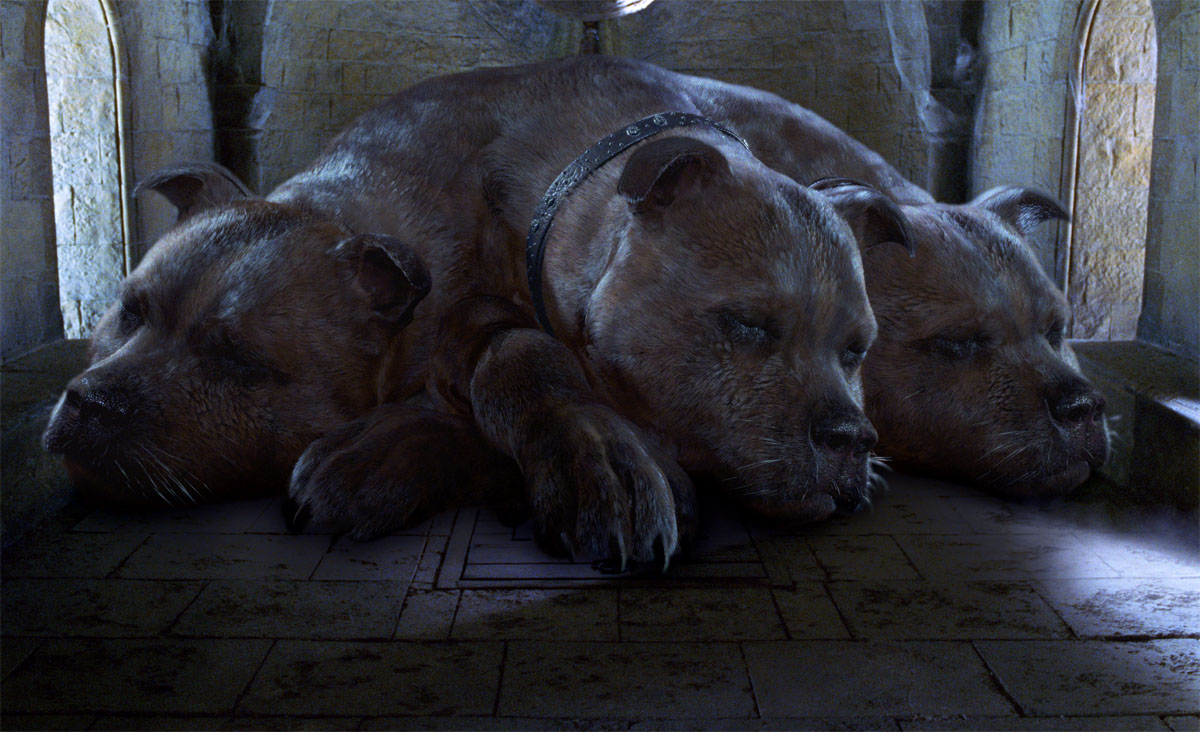
Even if we now slingshot all the mode through biblical and medieval music, Renaissance, Baroque and Classical, I tin't help merely notice: Long before we were angry at how expensive it was to own music, there was no owning music.
If you weren't in that location to heed, y'all missed it. The earliest recordings stem from the 1850s and commercial radio only started in the 1920s, taking yet some other xxx years to accomplish all countries. Thus, it wasn't too long agone when someone heard the radio host play the aforementioned song twice and asked: "Why can't I?"
That day, the fight for control over music began. Owning music had been beyond our grasp for thousands of years, but not much longer.
"Ah, music, a magic across all we do hither!" — Albus Dumbledore
We Were All Soldiers
Vinyl LPs simply took off in the 60s, which means in the curt span of 50 years we blasted through at least seven major formats of storing and — finally — owning music. I was born in 1991 and I have used all of them. Like most people, I also stole music using all of them.
Information technology started with the "Sharp 3-CD Rotary Disc Mini Component System" I got when I was 11. I would buy empty cassettes, tape songs off the radio and get mad if the host ruined the intro or ending.
Technically, that wasn't legal, but come on. Didn't nosotros all fight? Against how expensive it was to accept a decent selection of music? For our right to music. For freedom! Or so we told ourselves.
Maybe you recorded songs on tape too. Or exchanged burned CDs. Or got a friend to put music on your mp3-thespian. Peradventure the names Kazaa, BearShare, LimeWire and Napster sound familiar to you. Whatever you did, I'm pretty certain you did something. Something to insubordinate against the gatekeepers of music.
Without realizing information technology, we were all soldiers on a mission. Until in 2001, general Steve Jobs stepped on that phase and gave us "a thousand songs in our pocket." For the starting time time always, music was available in an like shooting fish in a barrel-to-use, lasting, portable, 24/7 access format at scale.
Finally! Music got the front end-row seat in our lives we always wanted it to take, and we paid for its ticket. Lurking in its shadow, embedded in the very device that was supposed to salve us, the virus sat. Waiting to infect united states of america.
With a single stroke of genius, Steve Jobs ended the fight, simply started a war.
"It will go down in history equally a turning point for the music manufacture." — Steve Jobs, talking about the iPod
Deed II: Compulsive Listening On The Ascension
Jobs was correct, simply he put the words in the incorrect guild. Information technology was a turning bespeak for the music industry, except it was also the thing going down. And it took us right with it.
When I got an iPod Mini for Christmas in 2004, I did exactly what Jobs suggested: I put my unabridged music library in my pocket. Immediately, the virus awoke. The name of the virus is compulsive listening.
Y'all may be familiar with the term compulsive consumption, which describes spending beliefs similar to that of a gambling aficionado, binge eater or alcoholic. On a global scale, we call it consumerism.
"The pursuit of the 'good life' through practices of what is known equally consumerism has go one of the dominant global social forces, cutting across differences of religion, class, gender, ethnicity and nationality." — Paul James in Globalization and Civilization
Compulsive listening is consumerism with our ears.
It'southward a trend that's just as universal and it tears music out of the once meaningful place it had in our lives. Right at present, I come across eight people around me. Six listening to music. People on the train, people in the street, people in their cars. All listening to music, all the time.
We don't heed to experience, we mind to office. It'south not "music on, globe off" it's "music off, life off." We need stimulus. Background noise. Lark. Something to nurse u.s. through the misery of our twenty-four hour period.
There are three reasons the virus has made information technology this far.
Closer
It took the radio 38 years to reach 50 million users. The iPod needed four.
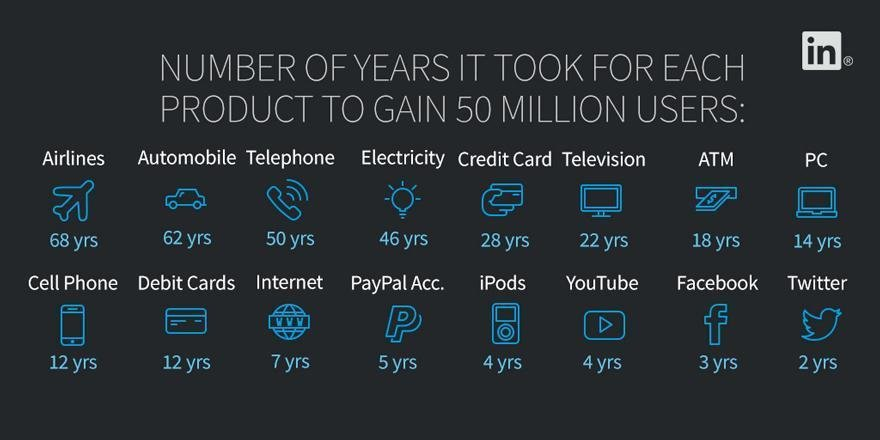
We're adopting new technologies faster and faster, because the net helps them spread and a lot of them start out free. But neither is a compelling argument why we should. We prefer because we can, not because it makes sense.
It wasn't practical to accept my Discman everywhere and believe me, I tried. The iPod changed that. And when I brought that with me virtually everywhere, the iPhone then made sure I literally had music locked and loaded 24/7.
With each new device, music came closer, eventually never leaving our side.
Cheaper
Music used to be expensive. It was expensive to make, expensive to sell, expensive to buy, store, transport and heed to. None of those things are expensive any longer. At to the lowest degree they don't have to be.
With the appearance of the iTunes Music Shop in 2003, one by 1, these barriers take fallen and enabled compulsive listening to thrive. Industry revenues peaked shortly before and vicious forty% afterward, reaching their all-time low in 2014.
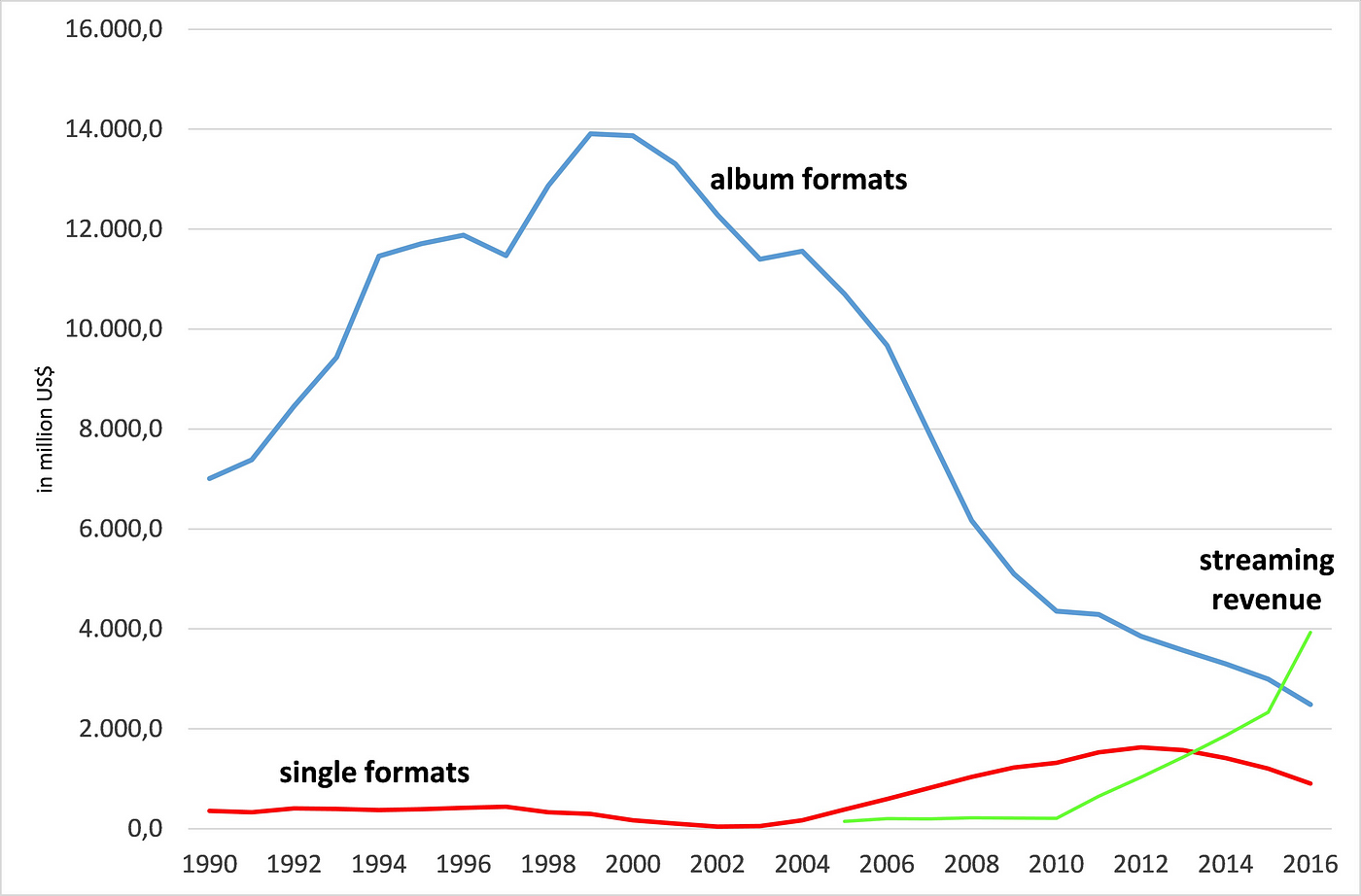
The recent uptick in streaming revenue, a ray of light for musicians, is the last nail in our coffin. Streaming music non just made information technology available seamlessly across all of our devices, information technology too gave usa the best price: free.
I signed up for Spotify in 2012. Since then, I not but kept music apps equally close as my wallet, merely opening them didn't hurt 1 bit. Of grade, like any good aficionado, I did the former anyway, just 9 months later.
Just if you're willing to heed to the occasional ad, yous can get a loftier-quality fix of your favorite drug, free of charge. E'er.
Longer
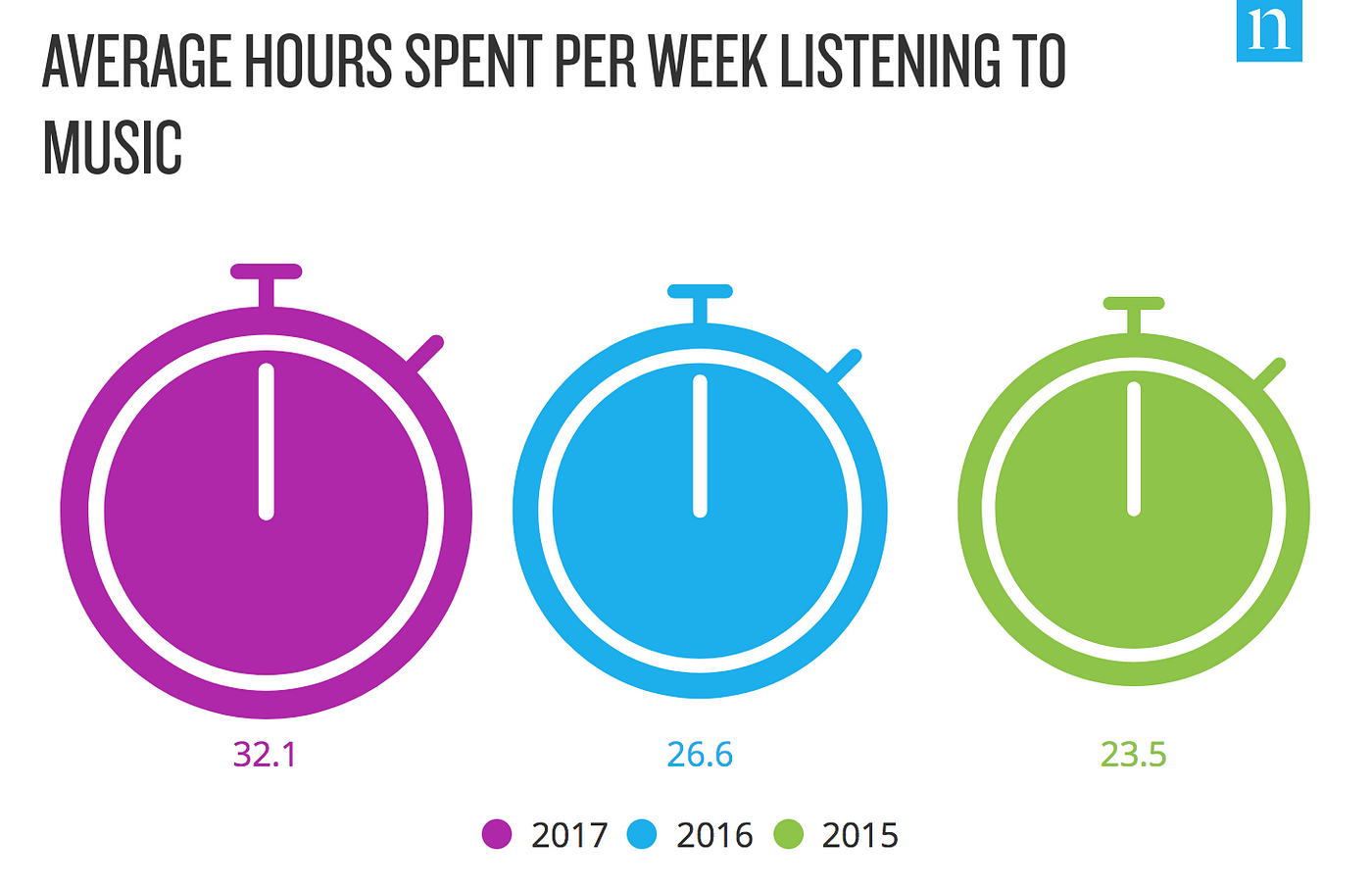
Music consumption is at an all-fourth dimension high and it keeps us high, all the time. With more 32 hours of pure listening time each calendar week, that's simply four hours shy of how much we work.
In fact, much of our fourth dimension is spent doing both. When Chris Coyier polled his readers, half of over twenty,000 people said they ever heed to music at work. Throw in 'sometimes' and the number goes to 92%.
Once more, technology is what enables united states to practise this in the first identify. With an average bombardment life of effectually viii hours and growing, music isn't simply free and always around, you can also printing play and never pause. Of course 75% of us also charge at to the lowest degree one time a 24-hour interval.
And while music isn't exactly multi-tasking, whether it helps yous focus depends heavily on what you lot're listening to. That'south because music, every bit The School of Life remarked:
"Music is there to take us beyond the everyday, to transcend the ordinary and survey ourselves from a lofty pinnacle. Music reconnects us with our instinctual bodily selves when reason, logic and subject field are in danger of crushing the states."
However, most of the time, staying in the realm of reason is exactly our chore. Persisting through the uncomfortable pressure is what's required of united states, but we can't do information technology when we're constantly floating on cloud nine.
Intermission
Technology may accept activated the compulsive listening virus, just there's 1 more than affair without which it never could accept hacked our immune systems: united states of america. The real reason for the autumn of music lies in human nature.
All the talk about music beingness a drug? It's truthful.
"1 expert affair about music, when it hits you lot, you feel no pain." — Bob Marley
The Truth: Our Brains Never Stood A Chance
Nosotros've all been to a wedding. Or funeral. Or large sporting event. If you've ever teared up to a classic tune or gotten goosebumps when the anthem resounds, you've witnessed the ballistic brain power of music. Going back to This Is Your Encephalon On Music, Levitin explains:
"Listening to music starts with subcortical (below-the-cortex) structures — the cochlear nuclei, the brain stalk, the cerebellum — and then moves upward to auditory cortices on both sides of the encephalon."
The oldest function of your brain is the function that reacts first. Information technology's in charge of your emotions and reflexes. From at that place, music cascades to every region of the encephalon nosotros know exists. And it goes right for your dopamine switch.
"Music uses the same reward pathways every bit food, drug and sexual pleasure," Levitin finds in a report. Valorie Salimpoor, who studied music's impact on the brain at McGill Academy, confirms:
"Peaks of ANS action that reverberate the experience of the most intense emotional moments are associated with dopamine release in the NAcc. This region has been implicated in the euphoric component of psychostimulants such equally cocaine."
Interestingly, this reaction is already triggered when nosotros merely anticipate our favorite songs, not just while we listen. So whether we're compulsively listening to music or thinking about music, Apple got what it wanted:
Nosotros never stop playing.
Over the past two decades, we take seen a slow rise in our power over music, that coincides with a hard fall of those, who make it for united states of america. The price we paid for that power is control. And as in politics, power without command is the enemy of freedom.
Music isn't quite as bad equally cocaine, of course. Since it's dopamine created past our own body, not an external substance, Salimpoor says information technology'southward "not necessarily a bad addiction that'due south going to destroy your life."
Only it doesn't always experience that way, does it?
Standing At The Edge
On that sunny September 24-hour interval last year, as I unsuspectingly walked into the kitchen, I saw my roommate. Just sitting there, eating. No music. No video. No Tv set evidence and no talking.
I but stood there, watching him. In that moment it finally hit me:
"I am way as well dependent on music."
Looking back, I can encounter many indicators. Like the times I cooked with headphones on. Or almost got hit in traffic. The times when I wished for music during exams or listened while talking to other people.
I love music from the bottom of my heart. Virtually of united states do. But I learned something that twenty-four hours: Even the brightest dear can turn into a festering virus if you obsess about it too much.
Information technology had to terminate. I — had to end. Or I would regret it forever.
"None but ourselves can complimentary our minds." — Bob Marley
Act III: Surrender Power, Take Back Control
Maybe y'all're standing at a cliff likewise. Mayhap y'all're not quite as close to the edge equally I was. The lesson I brought back from it will serve you lot all the same:
Give up ability and you can take back command.
The twenty-four hours I saw my roommate being aught but nowadays, I decided to take a walk without music. Wow. I was floored. I felt so…there. Present. Connected, non numb. I listened, just to listen. And any music the globe was playing, information technology was beautiful. Fifty-fifty without headphones and without sound.

Music is a wonderful gift. It'due south our gateway into the universe. But if that gateway is ever-nowadays and always open, its tempting allure will destroy the states. The ironic, cruel twist is that we never lost command. It's rested with u.s. all the style, from when nosotros paid Sting to transport united states of america a unmarried CD to the all-access pass that is Spotify. We tin can close the gateway whenever nosotros want. Equally long as we don't close it entirely, if we go out it open just a crack, we tin can e'er get back.
When I returned from my walk, I canceled my Spotify Premium subscription. I beat out the virus. I stopped paying to distract myself. What I imagined as a worst-case scenario turned out to be a status I didn't have to fright.
The music industry one time throve considering it forced us to determine on a small selection. That selection was never our enemy. It was our friend. Music was useful because it was part of our down fourth dimension. We sat in our chairs, on our beds and on the grass — and nosotros'd merely listen.
Today the music manufacture wants the states to be addicted to music, listening 24/7. The big players depend on our infection with the compulsive listening virus. The but way to get information technology out of our organization is to give up some of our power.
You don't need to cancel your access to your streaming service to do that. Only it'd be a strong statement if yous cut the headphone cord on purpose. Whether you choose to make such a statement or non, I'd like to present you with the alternatives I've been using ever since.
These tools volition give yous dorsum control over consuming music by limiting your selection. They've made me feel more than calm, present and go on to assist me focus. The commencement leads to mindfulness, calm, joy and happiness. The 2nd and third aid you use music to be more than productive.
i. Conscious Listening
If compulsive listening is the virus, and so conscious listening is the antidote. It's non so much about listening to less music, but about changing the way you heed. Deliberately choose songs. Select the right tracks for the correct occasion.
Here are some means to practice that:
- Carve out time solely dedicated to music. Pick an anthology, prevarication on your bed and merely heed. Take it all in.
- Become to the occasional concert. Prove upwardly for your artist. I never went to a Linkin Park concert and now, one of my heroes is dead. It's ane of the superlative 3 regrets of my life.
- Listen to the sound the world makes. Sit in a café or have a walk in the park. Hear the birds. Collect noises. Explore the metropolis with your ears.
- Melody in to your mood and option a song that fits. Listen to it from beginning to end. Pay attention to the lyrics. What does the vocaliser tell you lot?
- Detect new sounds in your favorite songs. What background noises are in that location? What instruments practice they use you haven't noticed? You can notice new magic in xx year old songs. You just have to look for it.
2. ListenOnRepeat
Two ways music tin can enhance productivity are for repetitive tasks and when its relaxing, depression-complication, groundwork music. In essence, yous desire the same pattern of sound, so the brain tin can get used to it. ListenOnRepeat is a great mode to do this.
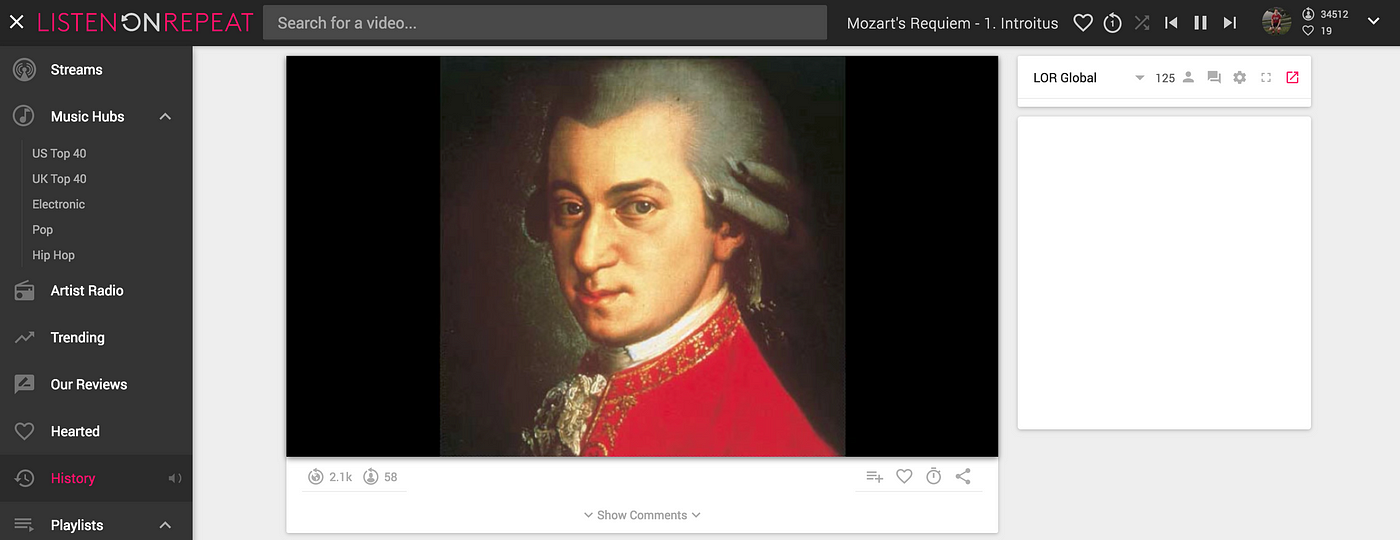
This tool loops any song yous find on Youtube or through their interface. There are iii ways to trigger it:
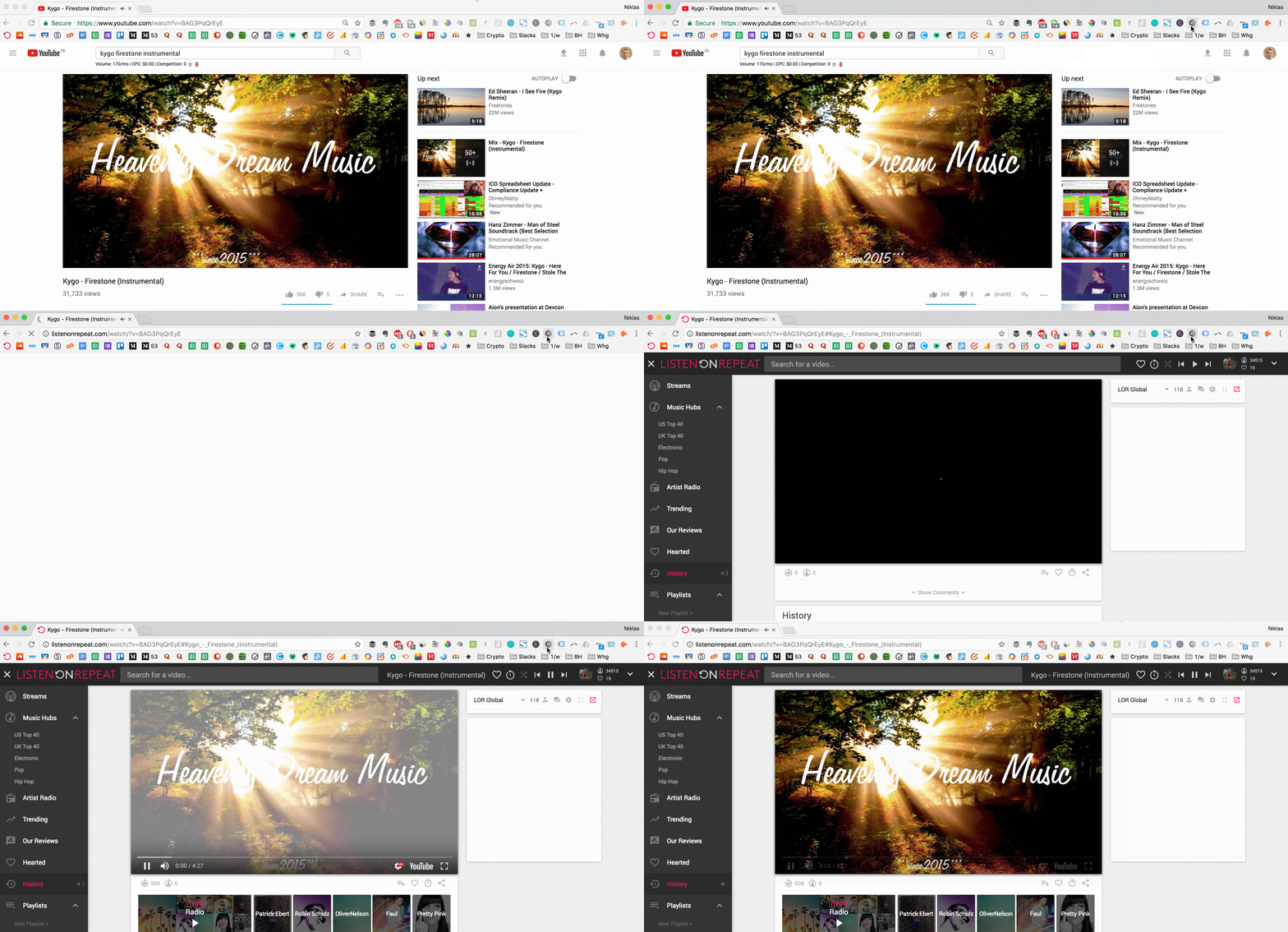
one. Add 'repeat' afterwards the give-and-take 'youtube' in any Youtube URL and hitting Enter.
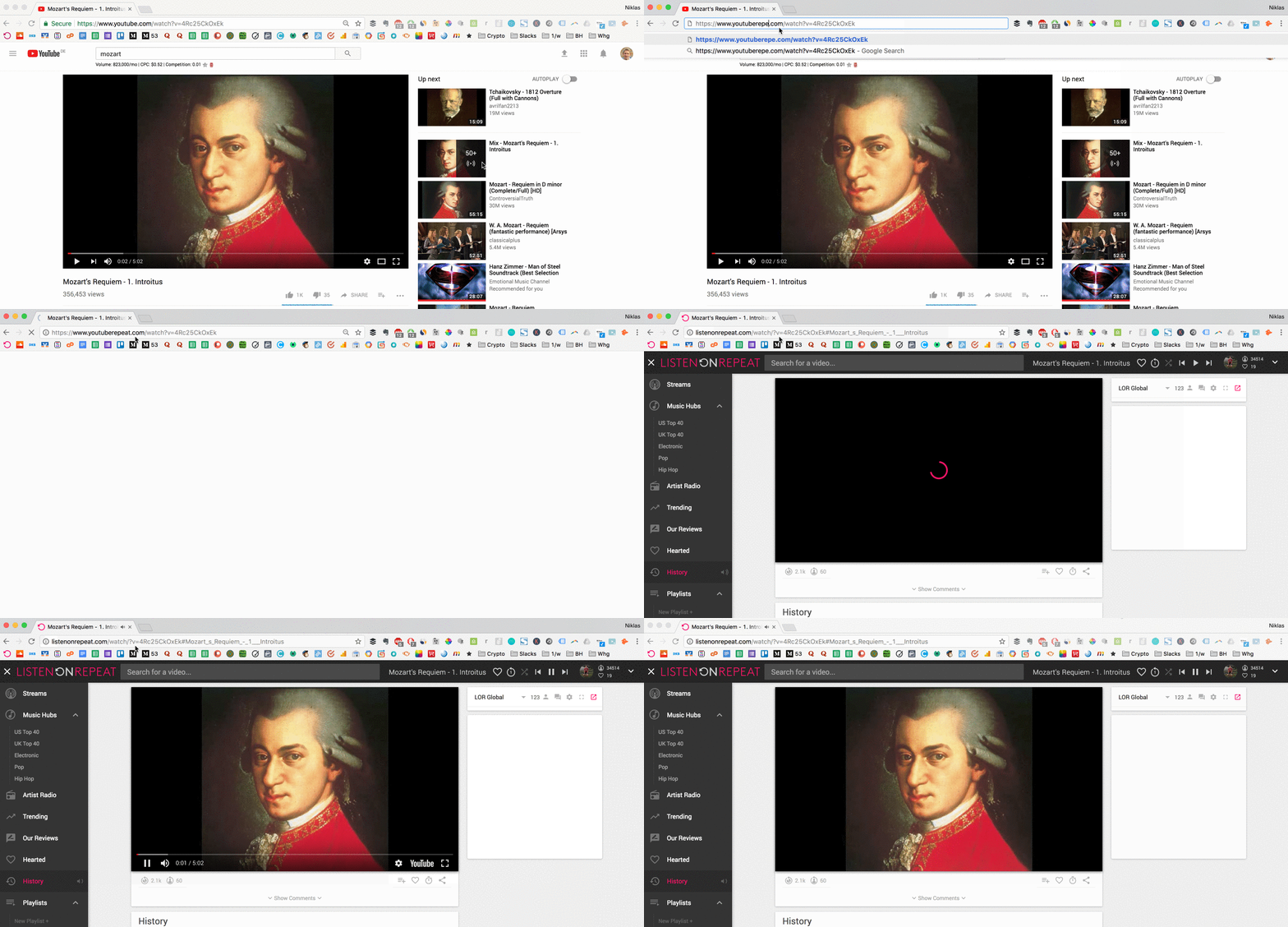
ii. Go to listenonrepeat.com and search for a song directly.
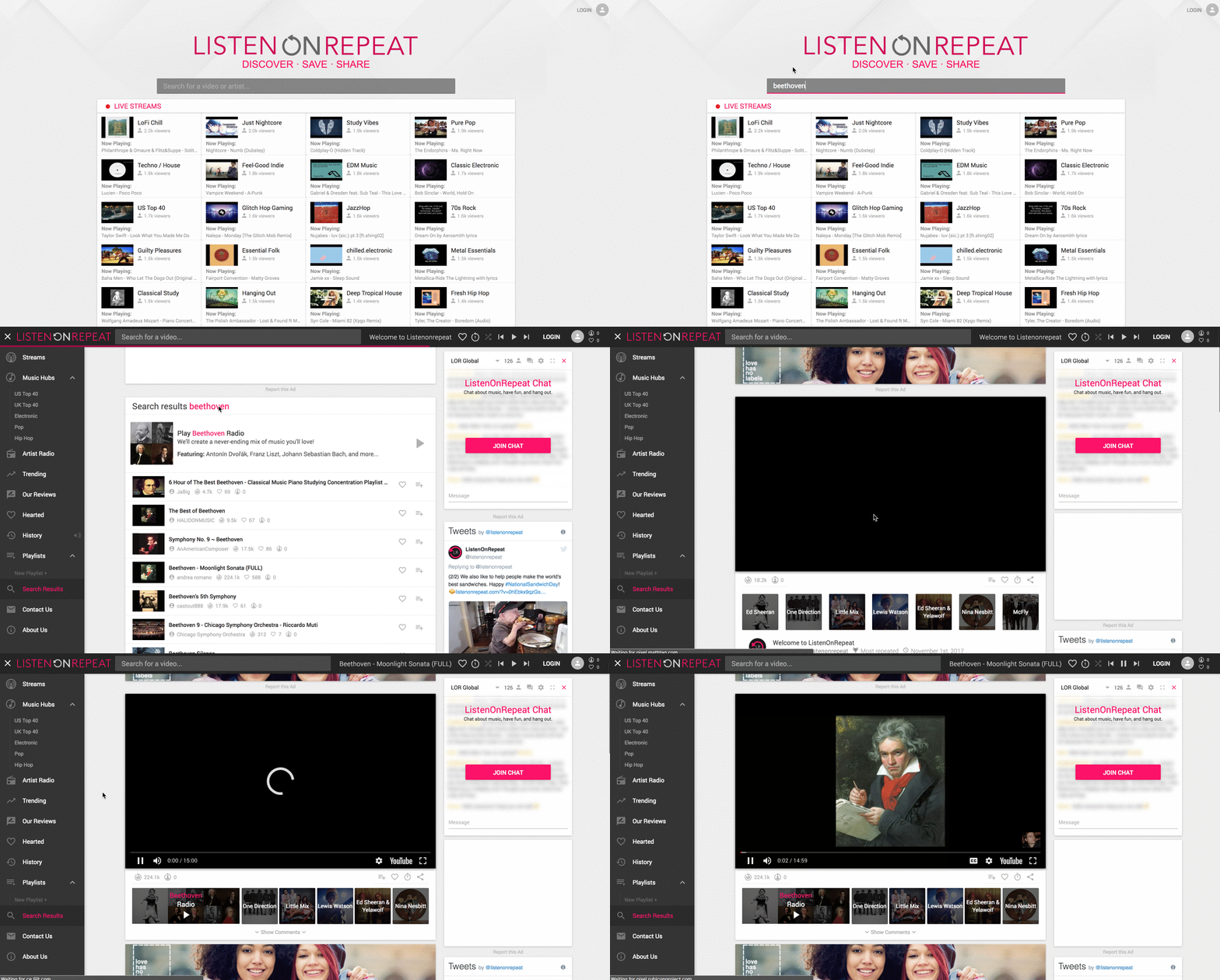
iii. Install the Chrome browser extension, then click the little loop button in your extension bar on any Youtube video.
According to scientific discipline, skilful songs are irksome to medium pace instrumentals at 60–eighty beats per infinitesimal, such every bit classical music, certain electronic music and movie or video game soundtracks. Bad songs are those with lots of rhythm changes and circuitous, fast lyrics. A hard stone rap crossover isn't platonic, for example.
Combine this with a Pomodoro timer and you lot get solid blocks of focused work. You tin even listen to music during breaks in order to induce heed-wandering and be more creative, Donald Chiliad. Rattner, AIA suggests.
Note: An culling is SoundCloud, which comes with a 'repeat' button in its control bar on the bottom of the screen. However, while it's great for looping songs from independent artists, it but keeps playing random tracks if y'all don't ready it to loop. That's bully for discovering new music, but information technology's also massively distracting if not washed on purpose. iii. Noisli
Some people say they demand their TV to be on to be able to fall asleep or that they find the audio of their ceiling fan soothing. What they're referring to is called white noise in science. While there is little testify of its general benefit to thinking and retentivity, Rattner says it may help in the ideation stage of solving a problem:
"At 70db, it's just loud enough to go on usa from concentrating so intensely on the problem that nosotros sideslip into a predominantly convergent mindset, but the sound isn't so overwhelming equally to completely distract us from our task."
Basically, silence or monotonous sound keeps your thinking in a tunnel, while moderate levels of dissonance put it on the highway. Yous encounter all the lanes you could bulldoze on, but you can't pull a 180 either. 70db is the equivalent of a coffee shop or noisy restaurant.

The perfect tool to create this noise level exactly the mode you want it is Noisli.
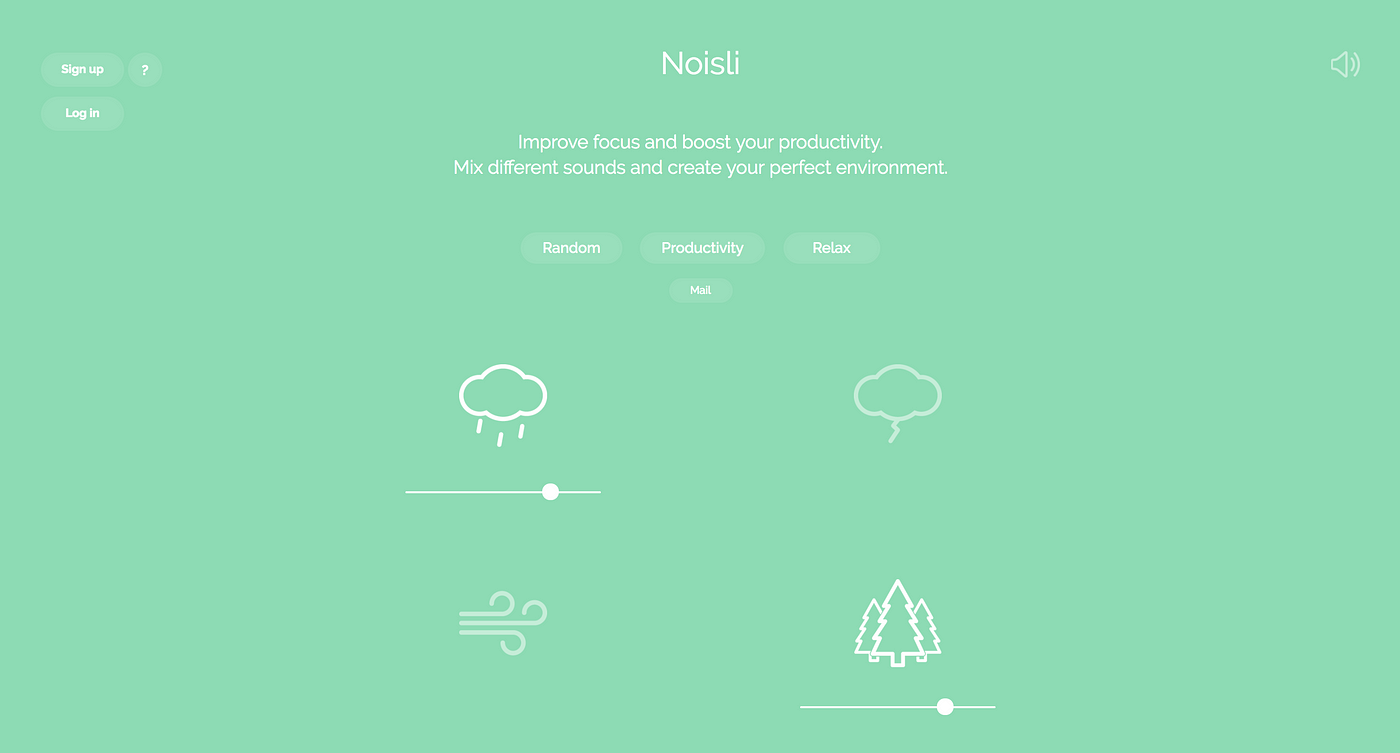
Simply open up the website, click on all the elements you desire to add together to your mix and accommodate the volume for each one. Some options are pelting, a thunder storm, wind, leaves blowing, flowing water, a crackling fire and a fan. You can also use their presets and save your own if you set upward an account.
In add-on, if you lot install the Chrome Browser extension, you can access the mixes you saved anywhere. It fifty-fifty comes with a built-in Pomodoro timer.
The Curtain Falls
Friedrich Nietzsche said "without music, life would exist a mistake." He is admittedly, undeniably right. But so is the inverse:
Music without life is as well a fault.
Possibly one that's even worse. Nosotros don't want to find out and nosotros don't accept to. All it takes is that every in one case in a while, you press interruption.
👉The Better Humans publication is a role of a network of personal evolution tools. For daily inspiration and insight, subscribe to our newsletter, and for your nigh of import goals, find a personal motorbus.👈
Source: https://betterhumans.pub/how-to-make-music-a-useful-part-of-your-life-again-e65ec72a27b9
0 Response to "1click Sting Running Down Again Extended Mix Zippyshare"
Post a Comment